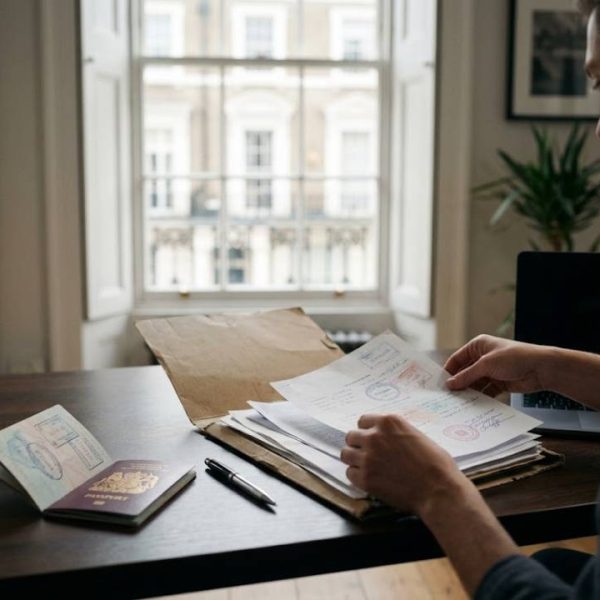
Most UK applications do not fail because the evidence is weak. They stall because a document arrives in the wrong language, or in the right language with a missing line at the bottom.
The Home Office is specific about translations, and caseworkers check them one by one. A perfect translation without the required statement can be treated as if it did not exist. Here is what applicants most often overlook.
Anything not in English needs a translation
If a document is not in English or Welsh, you need to send the original together with a translation. This applies to birth and marriage certificates, bank statements, payslips, degree certificates and police records.
It also applies to the parts that are easy to forget: stamps, handwritten notes, margin annotations and the back of a page. If it carries information, it should be translated.
The statement that makes it valid
A translation is accepted when it comes with a signed confirmation from the translator. The statement should say that it is an accurate translation of the original document, and it should include the date, the translator's full name and signature, and their contact details.
Many applicants send a clean translation and forget this paragraph. The page then looks complete but fails the test. Ask your translator to place the statement on every document, not only on the first one.
Who can translate
The rules do not require a government licence. They require someone who is competent in both languages and willing to stand behind the work. In practice, most applicants choose a professional agency because it removes any doubt about credentials.
Search for certified translation services London or elsewhere in the UK, and check that the provider names the translator, gives a signed statement and returns a file you can print or upload without edits.
Do not translate your own papers
Translating your own documents, or those of a close relative, often looks unreliable even when the work is good. An independent translator has no interest in the outcome, which is exactly why caseworkers trust the result.
The same goes for friends who speak the language well. Quality is not the question. Independence is.
Names and dates must match everywhere
One of the most common problems is a name spelled differently on two documents. A passport may transliterate a name one way, a certificate another. Send your passport to the translator so the spelling is consistent across the file.
Dates need the same care. Write or ask for the month in words, because 04/05 means April in one country and May in another.
Apostilles and legalisation
Some documents also need an apostille, which is a standard stamp that confirms a public document is genuine. It is not the same as a translation, and one does not replace the other.
If you are unsure which one your papers need, this short explanation of apostille or certified translation shows how the two differ and in what order to handle them.
The same legal care applies to agreements people sign at home, such as a co-living contract between housemates who speak different languages. If the versions disagree on a deposit, a bill split or a notice period, the argument usually starts the day someone decides to move out. That is why accurate legal translation services combined with careful editing and proofreading matter for shared-living agreements just as much as for official paperwork.
Follow the official guidance
Requirements change, and each visa route has its own list of evidence. Always read the current guidance for your route on GOV.UK before you order anything, and save a copy of the page you relied on.
If the guidance and an adviser disagree, the guidance wins.
Mixed languages and handwriting
Some documents contain more than one language, such as a certificate with a stamp in a third language. Ask the translator to cover all of them and to mark anything illegible instead of guessing.
Handwriting is a frequent trouble spot. If a word cannot be read with confidence, a careful translator writes it as illegible in brackets. That is far better than a confident guess that a caseworker later proves wrong.
Check the file before you submit it
Read the finished translation against the original. Check each name, number and date. Make sure every page is there, in the right order, and that the translator's statement is attached.
Ten minutes of checking can save a refusal that takes months to fix.
Timing and turnaround
Short documents usually take one to three working days. Longer files take more time. Rush options exist, but they only help when the scans are clear.
Plan the translation early. Document collection, apostilles and posting often take longer than the translation itself.
Digital copies and originals
Many applications are uploaded online, so a clean PDF is usually enough. If you are asked to send paper, keep a scan of everything first. Store the original, the translation and the statement together in one clearly named folder.
What it costs
Short certificates are often charged per page, longer texts per word. Ask what the price includes: the signed statement, delivery and one round of corrections. Compare the final total, not the headline number.
A refused translation costs more than a correct one, both in fees and in lost time.
The bottom line
Translations are a small part of a UK application and a surprisingly common reason for delay. Translate everything that is not in English, attach the signed statement, keep names consistent and read the official guidance for your route.
Do those four things and the translation stops being the problem.